Showing posts with label Advertising Research. Show all posts

Sunday, 1 April 2012

Two Step Flow

The Hypodermic Needle Model was proved to "clumsy" for media researchers who were seeking more of a precise explanation about the relationship between the audience and the text.

As mass media began to expand and become more of an essential to life, those around the world did not become reduced to a mass of 'unthinking drones'.

Paul Lazarsfeld, Bernard Berelson and Hazel Gaudlet believed that audiences were 'opinion leaders' who then communicate to less active associates who they may have influenced. The audience then mediate the information they have recieved from the media and then the information is expressed by opinion leaders. Not being influenced by directly, creates a Two Step Flow.


This allowes researchers to realise that social factors are also very important to how audiences interpret the texts.

The Two Step Flow is what we wanted to achieve through our 'Energy Saving Lightbulb' advert, we hoped the end result would be word of mouth as well as the advert itself, reaching a younger generation.

Uses and Gratifications

In 1948, Lasswell suggest that media texts had the following functions for individuals and society;

- Correlation

- Entertainment

- Surveillance

- Cultural Transmissions

In 1974, Bulmer and Katz, expanded Lasswell's theory by suggesting that individuals may choose and use a text for the following purposes;

- Diversion; escape from everyday problems and routines.

- Personal Relationships; using media for emotional and other interactions e.g. substituting soap operas for family life.

Personal Identity; finding yourself reflected in texts and learning behaviour and values from these texts.

- Surveillance; information which could be useful for living e.g. weather reports, financial news, holiday bargains.
We want people to watch our 'Energy Saving Lightbulbs' advert because it is beneficial to them and it enables them to realise the importance it is to buy this product to allow themselves a sustainable future.

The Hypodermic Needle Model

This model was created in 1920 is a theory that explains how mass audience may react to mass media. This model suggests that audiences recieve the information through a media text, the audience does this without an attempt to process or challenge the text.


The model also suggests the experience, the intelligence and opinions of an individual have no effect on how the audience percieves the text.


However, this does not apply to the both of our adverts, we want the audience to be able to identify with both the 'Energy Saving Lightbulb' advert and the 'Taylor Swift Greatest Hits' advert. One advert gives out a very important message regarding the need to save the environment and the other is important to Taylor Swift fans.  

Reception Theory

By using the concept of an 'active' audience, work was needed to be done for the audience to be able to recognise and interpret a text, this would show how features such as age, class, gender and ethnicity affected their interpretations.

This was based on Stuart Hall's creation 'the enoding/decoding' model which is about the relationship between audience and text. The text is encoded by the producer and decoded by the audience.

Encoding and Decoding Model

Using recognised codes and conventions, drawing upon audience expectations to aspects such as genres and the use of ‘celebrities’, the producer can control the audience and create an amount of ‘agreement’ on the codes meaning.

By using Reception theory, we are able to plan out and decide what would make the perfect 'Taylor Swift Greatest Hits' advert because our main audience we want to appeal to are those who are already her fans.

Thursday, 1 March 2012

Controversial and Banned Adverts

Every year, the UK sees millions of adverts promoting a product, a service, a charity or even trying to gain awareness for a campaign, the vast majority of adverts that are aired on television comply with the ASA's rules.

In 2010, the ASA recieved nearly 29,000 complaints about adverts that were seen by consumers. The ASA assessed the concerns that were made about these adverts and were investigated, resulting in nearly 2,400 adverts were requested to either be changed or were withdrawn from viewing.

In order to have a successful advert, its important that our advert complies with the rules as well, when planning our advert we had to make sure that there was no possibility of a rule being breached.


Barnardo's Campaigns

Barnardo's campaigns are notouriously known for their controversial images they use for their campaigns. Over the years, they have used images such as a young baby with a cockcroach in its mouth and bruises shown on abuse victims.


The image of a young baby with a cockcroach in its mouth was launched in 2003 and recieved more complaints than any other advert that was shown that year, recieving 466 complaints.
The advert was upheld to which Barnardo's said they were 'disappointed' by this decision as their ultimate goal was to spread awareness for child poverty.

Barnardo's is infamous with several images used to create awareness for poverty, including one with another baby with a syringe in its mouth, Barnardo's claimed that the adverts "showed the reality of poverty and its long term effects." Barnard's refused to apologise for the advertisement, arguing that the issue of child poverty was often ignored by the media.


Other Billboard advertisements have also been banned because they have caused some kind of offense to the public.


An advertisement of Tony Blair, advertising ID Cards was released in 2006, was the most complained about advert in that year and was banned because "the barcode on Tony Blair's upper lip made him resemble Hitler, which was offensive."


An advertisement promoting the TV show 'Six Feet Under' caused some controversy as viewers found it to be "offensive, shocking and likely to cause undue distress", the advert was made banned in the UK.


This advertisment was released to advertise the 'Quit Smoking' campaign. The advertisement featured two cigarettes to resemble the Twin Towers, with the tagline "No More Killing" to represent the 9/11 attacks. The advertisement was rejected in China for being seen as "inappropriate."
The advert caused offense to some viewers and the advertisement was then banned.
In 2010, the Irn Bru drink released an advertisment to promote their drink, the advert featured animated animals and had a Pied Piper theme to the advert by having the animals follow wherever the protagonist went. However, the advert turns from a happy, bright theme quickly to a dark, disturbing theme when the animals are led to a butcher shop.
The advert had already recieved a restriction given by the ASA, which meant the advert was not allowed to be shown around programmes that were targeted for children, however the advert still recieved a number of complaints arguing that the content was "offensive, irresponsible and distressing to children." The ASA felt its previous restriction to the advert was acceptable and the advert was not banned.

An advertisement advertising a cleaning product caused some offence to its viewers because of its use of "gender stereotypes", its tagline is "So easy a man could do it." Complaints were made against the advert but the ASA disagreed and saw the advert as "light-hearted" and "comical" and was unlikely to cause widespread offence.

The Restriction of Adverts

In January 2, 1971, advertisements that featured cigarettes in them were banned from American TV, alcohol products use is allowed in adverts however there is not allowed to be any consumption of alcohol in any advertisement.


On 1 April, 2007 restrictions on when adverts featuring foods high in fat, sugar and salt would be shown on TV.

The idea behind this was to reduce the amount of exposure children had against products that were high in fat, sugar and salt, the reason for this was to try and improve children’s diets and prevent rising levels of obesity.

Before the restriction was made, 80% of food advertising was spent promoting foods appealing to children like sweets, soft drinks and cereals.


Figures for obesity showed that it had tripled in the last twenty years, one third of all children aged 2-15 were considered obese which is a contributing factor to heart disease, cancer and strokes.


History of Regulation

Protecting Consumers and Testing Claims

In 1961, the Advertising Association decided that it was very important that advertisements were welcomed and trusted by consumers.

Because of this, groups such as agencies, media and advertisers decided to come together to form the Committee of Advertising Practice also known as CAP and released the first edition of the British Code of Advertising Practice.

In 1962, CAP established the ASA as the independent adjudicator under the new code created. This was set up to supervise the self-regulating system to protect the public.


Introduction of the Levy

In 1973 the Minister for Consumer Protection, Shirley Williams, criticized the system for not being well known enough by the public. As a response to this, the Advertising Standards Board of Finance (ASBOF)  was set up in 1974 to provide sufficient and secure financial funding through a levy of 0.1% on advertising space costs.

The ASA is not responsible for collecting the levy itself,  the levy can also provide enough funding for the ASA to promote itself to the public.

Legal Back Stop

In 1988,  the Control of Misleading Advertisements Regulations was introduced and provided the ASA with the legal backing from the Office of Fair Trading (OFT). These regulations enabled the ASA to refer advertisers who continued to mislead claims and refused to co-operate with the self regulatory system, to the OFT for legal action.

The ASA still has the ability to refer advertisers to OFT for unfair or misleading advertisements. However, today they are referred under the Consumer Protection from Unfair Trading Regulations 2008 and the Business Protection from Misleading Marketing Regulations 2008, which replaced the Control of Misleading Advertisements Regulations 1988.

Referral to the OFT is considered to be a last resort and is only used rarely: the majority of advertisers work within the system.

Becoming the One Stop Shop

After forty years of successful self regulation of non-broadcast adverts, in 2004 the ASA and CAP system assumed responsibility for TV and radio adverts.

The co-regulatory agreement created for the first time in the UK a single regulator for advertising – a one-stop shop for advertising complaints.
To create the one-stop shop, institutions similar to the ASA and CAP were established. The Broadcast Committee of Advertising Practice were created to write and maintain the Broadcast Advertising Codes.

The Broadcast Advertising Standards Board of Finance (BASBOF) were established to collect the 0.1% levy on broadcast advertising space costs and an ASA (Broadcast) was launched to administer the Codes.

The system runs as a single advertising regulator. This is particularly important for members of the public who want a complaints system that’s easy to navigate.

The ASA recieved 100 complaints in its first year of operation, now it receives around 26,000 complaints a year. This is mainly due to the fact that the one-stop shop ASA is now well known and it has been made easier to complain.

Advertising Under Control

45 years later, the majoirty of advertising in the UK complies with the Codes. The ASA compliance surveys reveal that more than 97% of adverts are in line with the Advertising Codes.

The vast majority of TV and radio adverts are pre-cleared before they go on air. Free help and guidance is offered to non-broadcast advertisers publishing the millions of non-broadcast adverts in the UK each year, in the form of the Copy Advice team who offer free, independent and expert advice on how to avoid failing foul of the rules.

Because the industry is has to make self-regulation effective, advertisements that break the Codes can be withdrawn without the need to resort to legal action. A range of sanctions can be given as punishment. For example, advertisers who continue to flout the rules can be denied access to advertising media space.

Today’s self-regulatory system has come a long way since 1962, winning the confidence of consumers, industry and government along the way.

What’s next for advertising Self Regulation?

Over the years, the advertising self-regulatory system has responded to changes in society and media. The system is continuing to prevent any adverts that mislead, harm or offend. A major challenge for the system is to maintain standards in fast-developing new media as effectively as in established media.


Video on-demand

In late 2009, following the UK government’s decision that new rules relating to video-on-demand (VOD) services should be delivered under a co-regulatory framework.

The ASA entered into a co-regulatory partnership with Ofcom to regulate advertisements with VOD services. Because of the rise of VOD consumers, they are able to watch programmes at a time of their own choosing, it was necessary that these new services also comply with the same rules that are given to programming on TV.

In 210 the first complaint made against adverts accompanying VOD was upheld by the ASA, because the advert had not been shown during a suitable programme.

As with broadcast advertising, broadcasters who continually air adverts that break the Codes can be referred to Ofcom, which has the power to fine them or even take away their license.

Digital Media

In 1995 the self-regulation of the internet began as the ASA’s responsibility was extended to cover advertisements in ‘non-broadcast electronic media’.

Because of the growth in online content and usage, in 2007 the Internet became the second most complained about medium behind television - it had approximately 3,000 complaints per year - and has remained that number of complaints ever since.
However, nearly two-thirds of these complaints fell outside of the ASA’s responsibility as they related to claims made on companies’ own websites.

To address the regulatory gap and to broaden the existing protections for consumers and children online, it was recommended that the ASA extend its responsibility in digital media to cover marketing communications on companies’ own websites.

In 2010, the Committee of Advertising Practice (CAP), responded to the request of the extension by announcing that the ASA’s online responsibility was to cover advertisers own marketing communications on their own websites and in other non-paid-for space under their control, such as social networking sites like Facebook and Twitter. Journalistic and editorial content and material related to causes and ideas - except those that are direct solicitations of donations for fund-raising - are excluded from the ASA's responsibility.

The extended responsibility was put into practice in March 2011, following a six month period of time to allow the ASA and CAP to conduct training work to raise awareness and educate business on the requirements of the CAP Code.

Today, over 30 million press adverts alone are published in the UK each year. Consumers are enthusiastic recipients of advertising, who enjoy its entertainment value and make use of the information it provides.

The flexibility of the system to respond to changes in society and technology means self and co-regulation continues to be the most effective way to secure high standards in advertising – both for business and consumers.

All information taken and edited from the ASA's Official Website.

Submitting a Compaint to the ASA

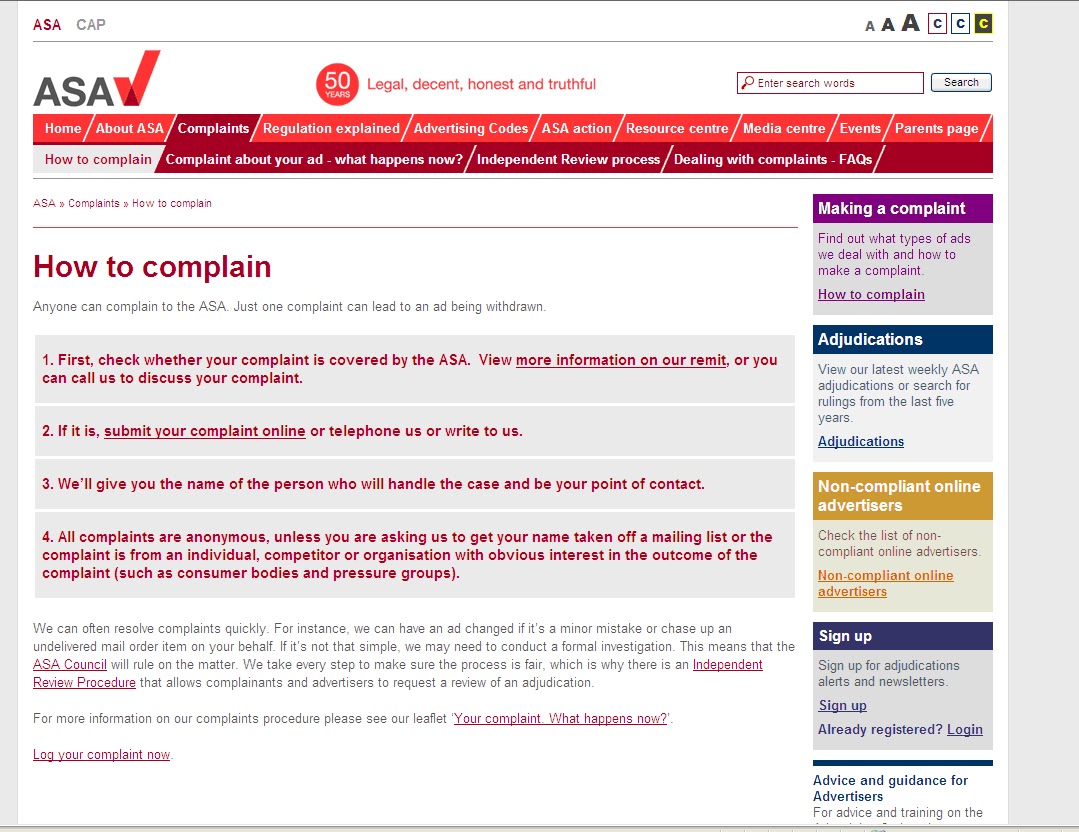
To show the process of what happens when a complaint is made to the ASA, I decided to make my own complaint to the ASA about an advert I had seen.


To begin submittign a complaint, the website takes you to a section of the site that offers the reader several options, including the option to see if the advert has already been complained about and also offers a link to sibmit a complaint.


Submitting a complaint is done in five steps, the first step asks the viewer who they are in society, the one I have selected is "Complaining as a member of public."


Step 2, then requires you to fill out your personal details, this is done for contact in case some needs to be made to the viewer.


Step 3 asks the viewer what type of advertisement it is, this shows that the ASA does not just deal with complaints about advertising on television but also other types.


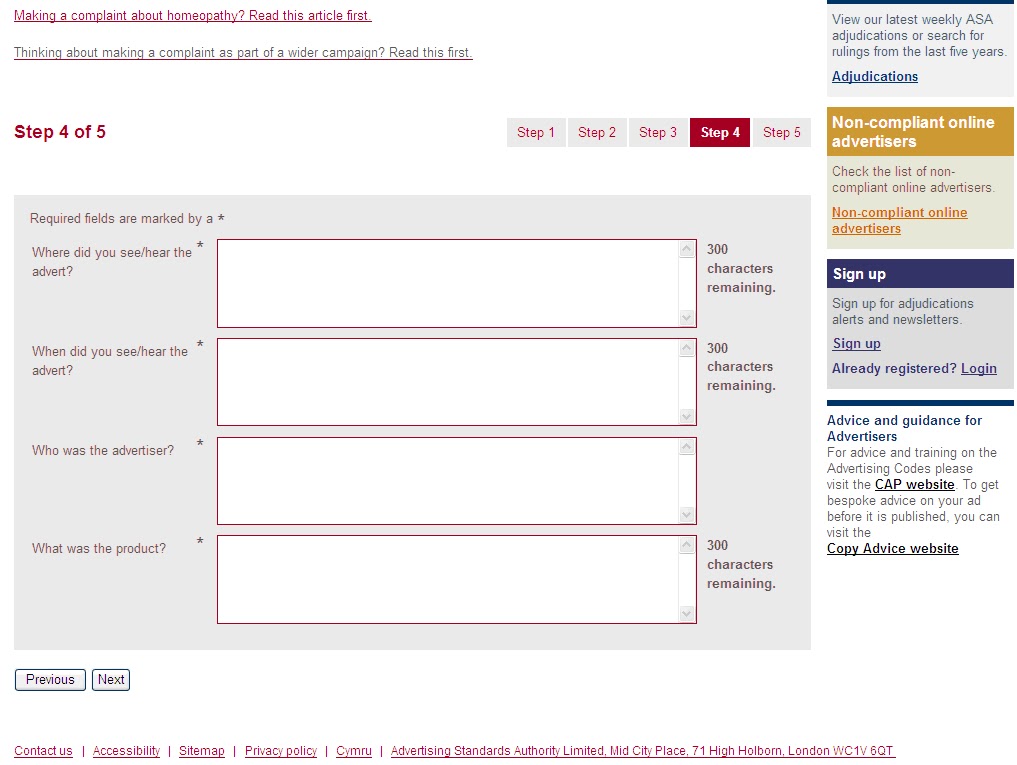
Step 4 asks a series of questions regarding the advert that is being complained about, these questions include 'What is the product?', 'Where did you see/hear about this?' etc.


The last step towards submitting a complaint requires a description of what the complaint about the advertisement is. Here, the viewer must detail why they are offended or think the advert is inapropriate of some sort.


This is the last shot shown once the complaint has been submitted, it details that a confirmation email will be recieved within a few working days, I have recieved this email which is shown below.


Wednesday, 29 February 2012

Advertising Standards Authority: Action Taken

Every year, there are thousands of adverts being promoted by companies wishing to sell products or services, however there also a minority of adverts that comply against the advertising rules. The importance of adverts for the ASA is that no advert harms, offends or attempts to mislead the viewer, adverts must be socially responsible.

The advertising codes do however, have specific standards for certain types of products that are being advertised and certain ways these products must be marketed. Some of these products include Alcohol, Health and Beauty Claims, Children, Medicines, Financial Products, Environmental Claims, Gambling, Direct Marketing and Prize Promotions.
These rules add protection to the consumer as well as consumer protection law and make sure that UK advertising is responsible.

In 2010, the ASA received just over 25,214 complaints about 13,074 adverts. The ASA assessed every concern and investigated the adverts which breached the rules. Because of this, 2,226 advertising campaigns were either changed or withdrawn in 2010.


Adjunctions;

The ASA adjunctions provide important guidance to advertisers on the Advertising Codes. They act as a transparent record of the ASA policy for consumers, media, government and industry. They also allow society to know what is and isn’t acceptable in advertising.


Sanctions;

The majority of advertisers comply with the ASA codes, but for those that do not comply with the codes, there are consequences regarding this. Some sanctions can reflect badly on the companies as one punishment could result in bad publicity which may cause the company to lose some consumers, their reputation could be damaged if the company is seen continuously ignoring the rules.


Non-Broadcast;


Most of the sanctions that are given to non-broadcasted advertising are given through CAP (Committee of Advertising Practice) There are several different CAP sanctions which are given for different circumstances.


Advert Alerts;


CAP can give out issue alerts to its member and the media, advising them to withold services that advertise certain products such as access to space.


Withdrawal of Trading Privileges;


Members of CAP can revoke, withdraw or withhold recognition or trading privileges, an example of this is the Royal Mail could withdraw its discount for bulk mail which could cost companies and marketing campaigns a lot more money.


Pre-Vetting;

Advertisers who continuously offend could have their marketing material vetted before publication, pre-vetting can last for long periods of time.


Sanctions in Digital Space;


CAP have more sanctions that can be invoked to make sure that marketers claims on their own websites or those using non-paid space comply with the CAP codes.
CAP can ask those who do not comply to remove them from their websites.


Broadcast:

When it comes to advertising through broadcasting, the choice of withdrawing, changing or rescheduling is decided by the broadcasters. They are obliged to follow the ASA rules, if they continuously run advertisement that are against the rules, there is then a risk that the broadcasters may be referred to Ofcom by the ASA, Ofcom can then fine the broadcaster or even withdraw their licence to broadcast.

Advertisers also suffer from this consequence, an example of this would be bad publicity which would come from an upheld complaint to the ASA. Advertisers may have lost huge amount of money from this advert that is now banned and won't be used to promote the product and lost the income they may have gained from it. Any advertisements that break the codes are disqualified from industry awards, denying advertisers and the agencies the created the adverts the opportunity to showcase their work.

All information taken and edited from the ASA Official Website.


Convergence and Media Consumption

Convergence is becoming more important to companies as it begins to become more popular, it is essential for advertising for companie to be able to distribute their products around the globe.

Originially and still today, adverts were played on the television, on most channels excluding BBC channels, this was the biggest way that viewers were shown different types of products to buy, however as times have changed and the internet has grown, television is no longer the biggest way to promote a product though it is still one of the biggest.

There are many different ways that the audience can now be exposed to advertising as well as television and radio, these include;


Internet;

The internet has many different ways to advertise different types of products, it gives direct links to websites to buy the products and provides pop-ups of products that may interest some viewers. However, its biggest advertiser on the net is most likely to be YouTube.

Youtube is described as a video-sharing website, where any individual is able to upload any type of appropriate video content to the site. As YouTube's popularity has risen, other major corporations have also made a channel in order for themselves to be able to upload their own content as another way to advertise. As some videos on the site gain millions of viewers, companies see it as a positive way to advertise to other audiences across the world.

These companies include BBC, Channel4 and can upload anything between News Programmes to Movie Trailers. YouTube also has many adverts uploaded to its sites that go many years back, adverts from the 90s, 80s etc. Including adverts that are no longer shown on television.


Social Networking;

There are many different websites that involve social networking that have cropped up on the internet over the years, some of these include; MySpace, Friends Reunited and Bebo. The most popular social networking websites on the net are most definitely Facebook and Twitter. 

Facebook launched in 2004, it has over 800 million active users, users are able to create a personal profile and add personal details about them if they choose to, add other users as friends, upload pictures and exchange messages between one another. Also, users are also able to link other users to videos, this is one way of successful advertising as it means the advert has made some kind of impact on the viewer. Other ways of advertising on the website is through people's comments about a certain product they may have bought or wish to buy, websites that they have visited and sharing links to products they want to buy or share an interest in.


Twitter is similar to Facebook in the sense that a user is able to create an online profile and the main use of the website is by having conversations with others or making comments. However, instead of adding friends the option is to 'follow' other users who may then wish to follow you back. Also instead of uploading a status like Facebook, you can upload a 'tweet' using a limit of 140 characters on Twitter. Users are also able to share links between others and upload pictures. The website was created in 2006 and since then has had over 300 million users and over 300 million tweets. Many websites are now making their own twitters with the option for consumers to follow them which gives them updates or even sneak peeks as a marketing concept to new products to gain more publicity.


Using social networking sites to advertise is a great way to get more advertising out there since people are constantly sharing links with one another, allowing adverts to travel from consumer to consumer much faster then any advert on the televsion would be able to. 


Phones;

People are now able to carry around small devices such as phones where they are able to get in touch with people all around the world. Phones like Smart Phones or Blackberrys or iPhones offer an option to access the internet, here they are able to access websites like YouTube, Twitter or Facebook at any given time. Within minutes, you are able to download or watch an advert on your phone with excellent quality.


This research gives good ideas as to how to advertise our own advert and what would be the best way to gain viewers. It also tells us which better ways there are to upload a certain advert, for example, our 1-2 minute advert might do better being uploaded to YouTube whilst our shortened, 30 second advert might do better being able to be downloaded through a Smart Phone.

TV Advert Theories

Adverts need to be creative and memorable and every Creative Director should know about advertising theory, one way to understand how most people decide what to purchase is with a tool called Consumer Involvement Theory.

In order the begin producing an advertisement, the first step is to consider what the company wants the consumers primary reaction to be towards the advert. This is not needed for all adverts, particularly those companies that have products that are already well established but new company may choose to go back to basics.

There are considered to be three different primary reactions that could occur when watching an advertisement;

- To think, to understand and to maybe remember.

- To feel and to experience some sort of emotion.

- To take action and do something.

The goal of branding is to be able to get people thinking about the product or service the company is trying to promote, the ultimate aim of advertising however, is being able to influence the viewer into becoming a consumer of the company's product, in order to do this, the company must be able to gain viewers and establish a relationship between the product and the viewer, getting them to like the product and want it.

Direct Marketing and Direct Responses are more about the audience responding to a click of a website, or picking up a phone to place an order for the product, each of these ways means a product could be brought in minutes.

However, to advertise on the television, the advertiser must know how to evoke a reaction within a viewer, the viewer may not respond to the advert at all or they may feel something towards the advert, the advertiser must know how to be able to advertise its product to its target audience and if there is more than one, know how to advertise it to a wider audience.


Children's

To appeal to a younger audience, it is more likely to gain attention to the viewer with the use of colour, cartoons or even familiar characters that the younger viewer may recognise.


The advert is promoting a children's toy which features the character 'Hannah Montana' from the same titled show, the advert would appeal to young children who had watched the show and therefore recognise the character because of this a relationship has already been established between the product and the consumer. The advert also uses songs from the show which the child may also recognise and want the product.


Humor

Humorous adverts generally appeal more to an older audience, usually in these types of adverts the humour is subtle and usually reflects a real-life situation that the viewer could or may have found themselves in.

The 'John Smiths' advert uses what is considered to be a 'Typical British Man' who makes himself look foolish over the course of several different adverts. The advert is promoting a brand of Beer, which already alienates the younger audience since there is an age restriction.
The advert also uses a well-known comedian 'Peter Kay' as its leading man which immediately targets the comedians fanbase into paying attention to the advert when it airs.

Sex Appeal is also commonly used in adverts when selling a product, the most common products that use sex appeal in adverts are usually for products such as perfume or aftershave. This is can be used to appeal to the consumer - which are mostly aimed for women - because it can target the women with the idea that if this product is making one women feel attractive, then it can make them feel that way too. Perfume adverts also appeal to men for gift ideas as perfume is a common bought gift for women from men.


Forms and Conventions of Advertising

There are several conventions that adverts generally follow, these act as a guidline to ensure the advert is viewer-friendly.

Conventions;

- The advert manages to make a connection with the audience.

- To make a successful advert, the advert needs to be easy for the audience to recall it, it needs to be
   memorable.

- The advert must make sure all information is correct and easily understandable for the viewer,  the viewer must not be confused, this makes an unsuccessful advert if the viewer doesn't understand what is being sold.

- The advert must get the necessary information out as quickly as possible, whilst still making sense to the audience.


Types of Adverts;

Entertaining:The comparethemarket.com website is now ranked as the 4th most visited insurance website in the UK – up from 16th in January 2008; sales have more than doubled year on year as a result of the TV ‘meerkat campaign’.

As of August 2009, Aleksandr, a character featured in the meerkat campaign, had more than 700,000 Facebook fans and 22,000 followers on Twitter, while on a photo-sharing site called Flickr there is a photo gallery of Aleksandr's family, all this helps promotion of the insurance site, itself.

The character remains extremely popular and even a record company has expressed an interest in releasing a single featuring the character Aleksandr.
The meerkat campaign has been extrememly successful in its advertising, as it has continued over a span of several years, people will tune in to see the latest installment of the meerkats, the campaign has also has successfully launched merchandise for the website, promoting a free 'meerkat' with several to choose from, when you join the insurance site.

Following adverts is not a new thing, in the past there have been several 'story-like' advertising, where there is the same character in the advert, with each new advert there is a new 'storyline' following the character as well as the promotion of a product, popular adverts like these include;

Nescafe Coffee;


 BT;


Other types of media aside from continuous adverts featuring the characters have also come from the advertising, particularly the Meerkat campaign.

Since the first Meerkat advert aired, there has since been a number of other merchandise surrounding the meerkats including books; In 2010, a book titled "A Simples Life: The Life and Times of Aleksandr Orlov" was released in October. The book gained more pre-orders then any book that was released at that time, including Tony Blair's memoirs and also doubled in pre-orders then Danni Minogue and Cheryl Cole's autobiographies.

There have also been several downloads available since the launch of the website, including wallpapers, text alerts, ringtones etc. Following the iPhone application trend, there has also been an application that consists of meerkat background information and meerkat translations available in a download for the consumer.  Meertkat Downloads


The biggest piece of merchandise since the campaign started however was the plush toys of the characters featured in the adverts, with several types to choose from.


Sentimental;

A sentimental advert allows the audience to be more engaged into the advert, it entices them into viewing and also makes the advert very memorable if it emotionally touches the viewer.

An example of this advert is the Google Chrome 'Dear Sophie' advert, released in 2011 to promote an internet browser, the advert consists of a father writing emails to his daughter as she grows up, the advert uses a potential use of the product is promoting in the advert though chooses the most heart-wrenching possibility to touch viewers, particularly those with children themselves. The advert has recieved over four million viewers to date, the advert was also voted as one of the top ten adverts of 2011 by The Globe and Mail.


The Advert has since recieved a number of positive reviews, these comments are taken from the video uploaded to youtube.


Serious 'Hard-Hitting';

A serious 'hard-hitting- advert usually tends to be an advert promoting a charity of some kind, or even a type of illness, initiating awareness. The advert usually uses some form of statistics of footage that was designed to shock its audience, the more shocking and hurtful, the more likely the viewer is to give money to the organisation etc.

Television Advertising

A television advertisement is a type of media showed on television which is produced and paid for by an organization, these advertisements convey a message, the general use of a television advertisement is for the promotion of a product or service. Advertising revenue provides a significant portion of the funding for most privately owned television networks.

The majority of television advertisements today consist of brief advertising spots, ranging in length from a few seconds to several minutes (as well as program-length direct resonse adverts). Advertisements of this sort have been used to promote a wide variety of goods, services and ideas since the beginning of television.

United KingdomIn the UK, the British Broadcasting Corporation is funded by a licence fee and only features adverts that promote its own programming. On the other channels that allow other advertising besides their own has a specific amount of airtime allowed by the UK broadcasting regulator Ofcom for advertising. The overall average is 7 minutes per hour, with limits of 12 minutes for any particular clock hour, in the evening this changes to 8 minutes per hour between 6pm and 11pm.

With 42-minute American exports to Britain, such as Grey's Anatomy which are given a one hour slot, nearly a third of the slot is taken up by adverts or trailers for other programs, movies and products.

Live imported television programs such as WWE Raw show promotional material that is shown in place of U.S. advert breaks.

In 2008, Ofcom announced a Review of television advertising and teleshopping regulation, with a view to possibly changing their code, Rules on the Amount and Distribution of Advertising (RADA), which regulates the duration, frequency and restriction of adverts on television.

Wednesday, 1 February 2012

Advertising

Advertising is a form of communication used to encourage or persuade an audience (viewers, readers or listeners) to continue or take some new action. Commercial advertisers often seek to generate increased consumption of their products or services through "Branding," which involves the repetition of an image or product name in an effort to associate certain qualities with the brand in the minds of consumers.

Adverts are paid for by sponsors and viewed via various traditional media; including mass media such as newspaper, magazines, television adverts, radio advertisement, outdoor advertising or direct mail; or new media such as websites and text messages. Internationally, the largest ("big four") advertising conglomerates are Interpublic, Omnicom, Publicis, and WPP.

Modern advertising developed with the rise of mass production in the late 19th and early 20th centuries. In 2010, spending on advertising was estimated at more than $300 billion in the United States and $500 billion worldwide.

An famous TV advert for 'Compare The Market' which was now branded 'Campare The Meerkat' and has now expanded into a mini franchise, with collectable meerkats.

Virtually any medium can be used for advertising. Commercial advertising media can include wall paintings, billboards, street furniture components, printed flyers and rack cards, radio, cinema and television adverts, web banners, mobile telephone screens, shopping carts etc.

Television Advertising


The TV advertising is generally considered the most effective mass-market advertising format, as is reflected by the high prices TV networks charge for advert airtime during popular TV events.

The majorities of television adverts feature a song or jingle that listeners soon relate to the product. Virtual advertisements may be inserted into regular television programming through computer graphics.
The 2011 iPad advert allowed the viewer to identify with the products capabilities whilst having the jingle stuck in their head, allowing them to constantly be thinking of Apples new product.

Radio Advertising

Radio advertisements are broadcast as radio waves to the air from a transmitter to an antenna and a thus to a receiving device. Airtime is purchased from a station or network in exchange for airing the adverts. While radio has the limitation of being restricted to sound, proponents of radio advertising often cite this as an advantage. Radio is an expanding medium that can be found not only on air, but also online.

Billboard Advertising

Billboards are large structures located in public places which display advertisements to passing pedestrians and motorists. Most often, they are located on main roads with a large amount of passing motor and pedestrian traffic; however, they can be placed in any location with large amounts of viewers, such as on mass transit vehicles and in stations, in shopping malls or office buildings, and in stadiums.

When Coca-Cola advertise their products, they makes sure that the advertising is the same across many forms. At christmas, every year, Coca-Cola use the Santa Claus advertising, which has always proved successful.

Advertising Standards Authority (ASA)


In today’s world, advertising promotes healthy competition as it informs and entertains. The ASA ensures that’s consumers can both enjoy and trust the adverts they see.

ASA builds trust from the public by enforcing ‘Advertising Codes’ written by the Committee of Advertising Practice; they also act swiftly when marketing communications break the rules.

The Advertising Standards Authority send clear signals about what is and what is not acceptable in advertising across a wide range of sectors, every week. As a result, the UK industry’s commitment to responsible advertising makes sure the ads, the public see are legal, decent, honest and truthful.

The UK marketing industry recognised the need for trust in advertising when it set up the advertising self-regulatory system for non-broadcast advertising in 1961. Since then, the UK’s system of self-regulation has helped to ensure advertising remains responsible: honest advertising helps to keep customers coming back.

Today, the UK advertising regulatory system is a mixture of self-regulation for non-broadcast advertising and co-regulation for broadcast advertising.

This means that the system is paid for by the industry, which also writes the rules, but those rules are independently enforced by the ASA.
The system is a sign of a considerable commitment by the advertising industry to uphold standards in their profession.

All parts of the advertising industry – advertisers, agencies and media – have come together to commit to being legal, decent, honest and truthful in their ads.